
直播港澳台
Birkenstock goes public on New York Stock Exchange_我的网站

A | Birkenstock took a big step forward on Wall Street this week, taking the nearly 250-year-old German shoe and sandal maker public.The footwear, often seen as a counter culture shoe for hippies, and in more recent years influencers, has become must-have footwear for many people, but Birkenstock's Initial Public Offering, or IPO, which was originally priced at $46 per share, didn't attract the dress shoe-wearing stock brokers on Wednesday.Shares opened at $41, near the lower end of its expected range of $44 to $49 set a week prior, as Birkenstock CEO Oliver Reichert rang the opening bell in a room surrounded by traders sporting the opened-toed footwear and others waving the sandals in the air.Birkenstock Holding Ltd. sold nearly 10.8 million shares in the offering, which raised about $495 million on the day. Its shareholders sold an additional 21.5 million shares, according to the Associated Press."Through the strong reputation and universal appeal of our brand -- enabling extensive word-of-mouth exposure and outsized earned media value -- we have efficiently built a growing global fanbase of millions of consumers that uniquely transcends geography, gender, age and income," Birkenstock said in a recent regulatory filing with the Securities and Exchange Commission, according to the AP.What started out in 1774 as a somewhat frumpy, but functional arch support sandal has transformed into a cult fashion item and billion dollar business, bolstered with support from the recent blockbuster hit "Barbie" when Margot Robbie's character is forced to choose between high heels or the strappy suede footwear.In tandem with the opening on Wall Street, Birkenstock hosted three consumer activations in public parks throughout Manhattan and Brooklyn.To highlight New York as "the city that never stops walking," the brand created what it dubbed "Birkenfields" for a public sensory experience that explored the brand's nearly 250-year heritage and expertise in foot health.The global brand is deeply rooted in foot health maintenance as well as a family tradition of shoemaking: Its inventor sought to provide function, quality and tradition as Birkenstock's core values.Over 95% of Birkenstock products are assembled in Germany with more than 90% of their materials and components sourced from Europe, ensuring the brand meets "the highest environmental and social standards in the industry by operating state-of-the-art scientific laboratories for materials testing," according to a company press release.。
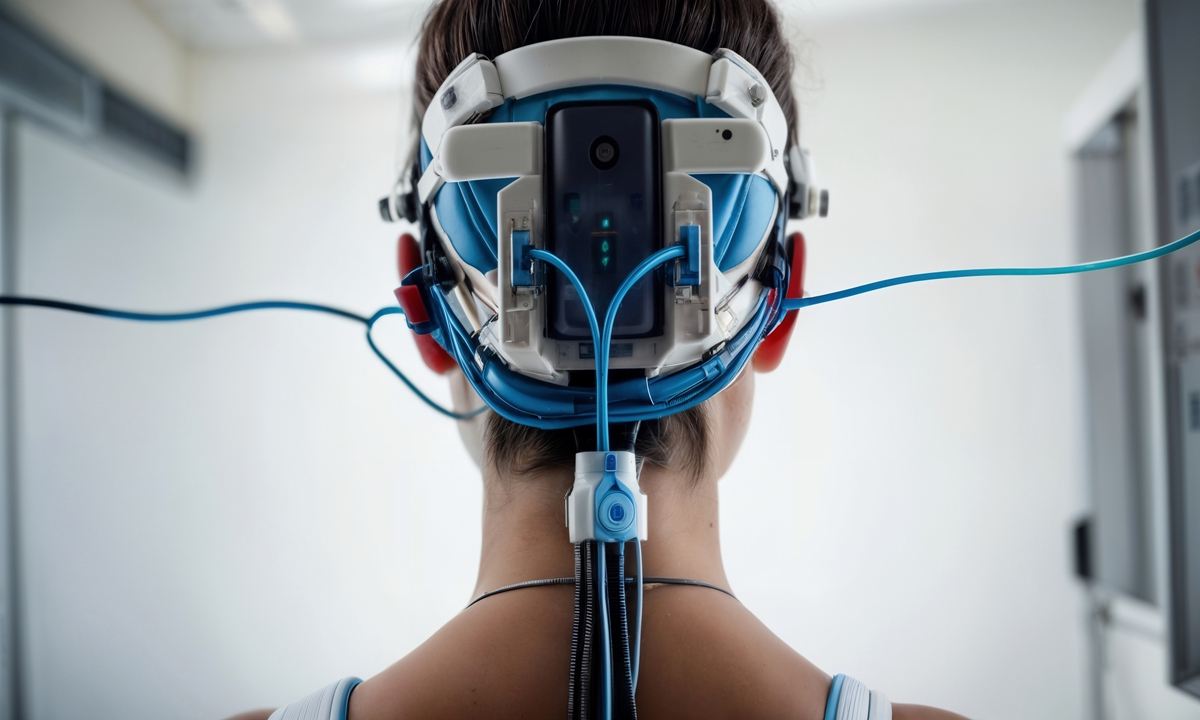
Chinese researchers have developed a multifunctional electrode coating that addresses key challenges in long-term brain-computer interface (BCI) implantation, including signal loss and tissue adhesion, bringing BCI one step closer to clinical application, the Global Times learned from the research team behind the findings on Sunday.
As an emerging field combining neuroscience and artificial intelligence (AI), BCI faces a major challenge of ensuring long-term compatibility between electrodes and brain tissue. Previous clinical trials showed that immune responses could cause implanted electrodes to retract after just three months, severely reducing signal quality and the number of available channels.
This problem stems from chronic inflammation triggered by implants, which creates insulating scar tissue around electrodes and separates them from neurons. Irreversible adhesion between electrodes and brain tissue after long-term implantation also makes device removal risky, potentially causing brain injury during follow-up surgeries.
Experiments showed that flexible neural electrodes coated with this material could operate stably in the brain for more than 300 days and could be safely removed without causing damage. This means the universal coating technology can make electrodes not only operate stably over the long term but can also be safely removed and replaced after aging, paving the way for long-term BCI applications.
Developed by the research team led by Zhang Wei at the Technical Institute of Physics and Chemistry, Chinese Academy of Sciences, associated with Beijing Tiantan Hospital, Shanghai Institute of Microsystem and Information Technology and NeuroXess, a high-tech life science company specializing in BCI technologies, the cationic alternating peptide electrode coating preserves electrode flexibility and conductivity, while offering antibacterial, anti-protein adsorption and immune-rejection-inhibiting functions.
A 300-day animal study showed the coating's effectiveness. Bare electrodes experienced a sharp loss of recording capability after 90 days of implantation and could barely detect neuronal signals after 300 days. In contrast, coated electrodes maintained stable recording channels and consistently captured neural signals above 155 microvolts.
In terms of neural modulation, after 300 days of implantation, conventional electrodes required a current of 100 microamps to induce weak limb responses, while coated electrodes triggered clear movements with only 2 microamps, improving modulation efficiency by 50 times.
Notably, the removal tests highlighted a key advantage of the coating that electrodes no longer form irreversible bonds with brain tissue. In the experiments, the coated electrodes were removed intact, with minimal damage to the surrounding brain tissue, Zhang told the Global Times on Sunday.
。
Current article:http://pos5i8.qiuergejiaolaiaozhuangshi.buzz/list_ctafh8/uhm.html
Published on:03:18:13